Key points
- CAN supports distributed, multi-node communication with strong error handling.
- LIN uses a single master to schedule communication with lower-cost slave nodes.
- CAN is typically selected for higher-performance or more critical systems.
- LIN is commonly used for local comfort and body-electronics functions.
- Modern vehicles frequently use both networks together.
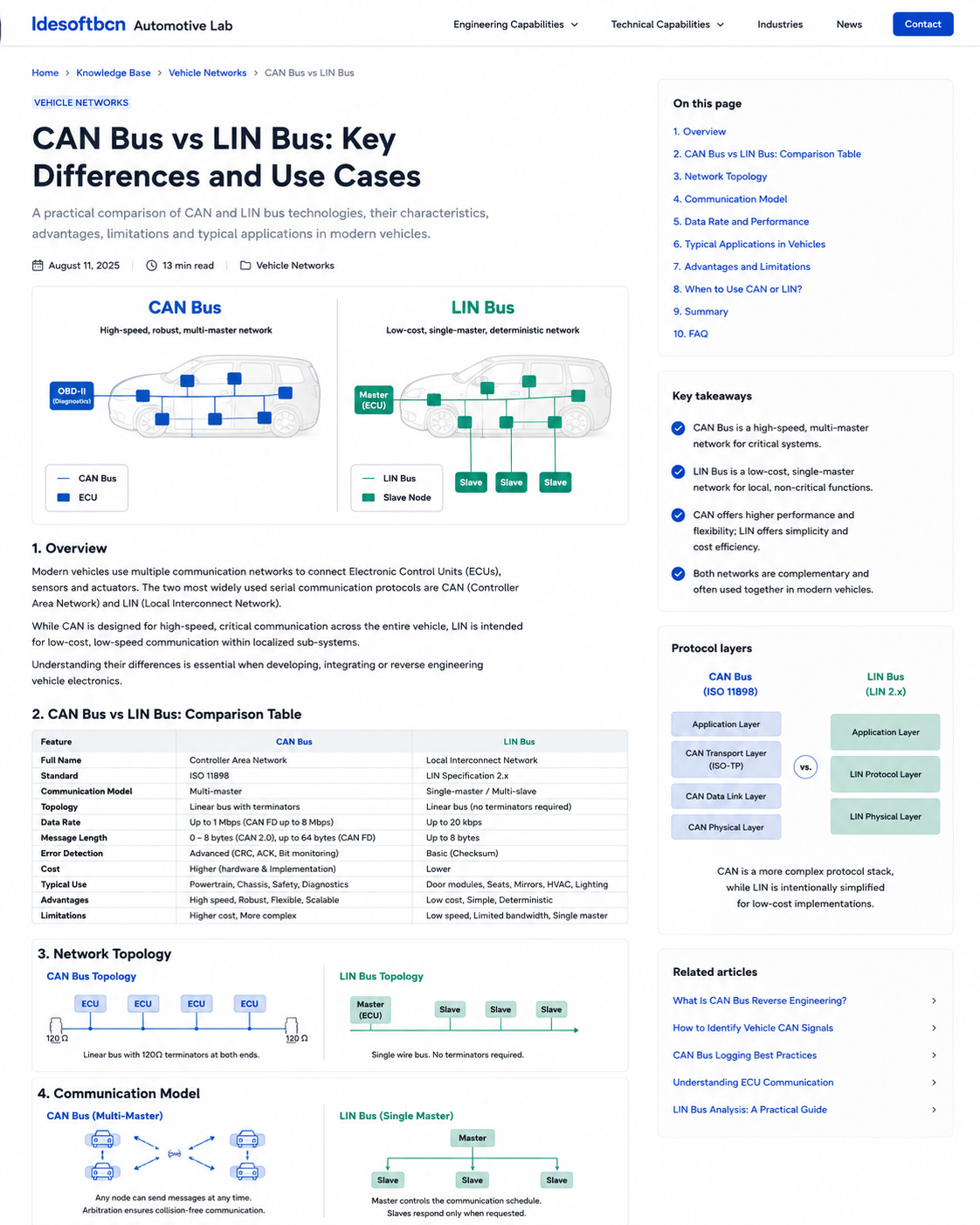
Overview
Vehicles rarely rely on one communication technology. Powertrain, chassis, body, infotainment and comfort systems have different requirements for bandwidth, latency, wiring cost and fault tolerance. CAN and LIN are two widely used serial networks that address different parts of this design space.
CAN allows multiple nodes to initiate communication and includes mechanisms for arbitration, acknowledgement, error detection and fault confinement. LIN uses a simpler master-and-slave architecture in which the master controls the schedule and each slave responds in predefined communication slots.
CAN Bus vs LIN Bus comparison
| Characteristic | CAN Bus | LIN Bus |
|---|---|---|
| Communication model | Multi-master, message-based | Single master with scheduled slaves |
| Typical purpose | Robust ECU-to-ECU communication | Low-cost local subsystem communication |
| Physical wiring | Differential two-wire bus | Single-wire bus plus ground reference |
| Complexity | Higher | Lower |
| Error handling | Advanced protocol-level mechanisms | Simpler checksum-based protection |
| Typical nodes | ECUs, gateways, controllers | Switches, motors, sensors, actuators |
| Typical role | Backbone or domain communication | Local subnetwork |
Network topology
A classical CAN network normally uses a linear bus with nodes connected along a twisted pair and termination at both ends. Good physical design matters because cable length, branch length, termination and electromagnetic conditions influence signal integrity.
LIN also uses a bus topology, but its physical layer is intentionally simpler. One master module controls communication with a limited number of slave nodes. This makes LIN attractive for door modules, seat systems, mirrors and other localized functions.
Communication model
CAN is message-oriented. Nodes transmit frames identified by a CAN identifier, and arbitration determines which message gains access to the bus when several nodes start transmitting. The identifier also represents message priority.
LIN communication is schedule-oriented. The master sends a header that defines which frame should appear, after which either the master or a slave publishes the response. Because the master controls timing, network behavior is predictable and implementation can remain simple.
Data rate, performance and reliability
CAN is designed for faster and more demanding communication than LIN. Its differential physical layer provides good noise immunity, and the protocol includes error detection, retransmission and mechanisms that prevent a faulty node from indefinitely disturbing the network.
LIN trades performance for simplicity and cost. It is suitable when signals change relatively slowly and when the subsystem does not require the same fault tolerance or bandwidth as a CAN network. Exact performance depends on implementation and vehicle architecture, so engineering decisions should be based on the required update rate and failure behavior rather than protocol name alone.
Typical applications in vehicles
Common CAN applications
CAN is commonly found in powertrain, chassis, braking, steering, gateway, instrument-cluster, diagnostic and body-control communication. The exact allocation varies by platform, and modern vehicles may use multiple CAN networks with different roles.
Common LIN applications
LIN is often used for window lifters, mirror adjustment, seat controls, rain or light sensors, HVAC flap actuators, lighting modules, steering-wheel controls and other local electromechanical functions.
When should an engineering team use CAN or LIN?
CAN is generally the stronger choice when several intelligent controllers must exchange data, when higher update rates are needed or when robust fault handling is important. LIN is a strong option when one controller manages several simple peripheral devices and cost, wiring simplicity and deterministic scheduling are priorities.
The choice is not always exclusive. A body-control ECU may communicate with the rest of the vehicle over CAN while acting as the master of one or more LIN subnetworks. In this architecture, the ECU also serves as a gateway between the two protocols.
FAQ
Frequently asked questions
Is LIN Bus a replacement for CAN Bus?
No. LIN is normally used as a lower-cost local network for simpler functions, while CAN supports higher-performance and more robust communication. They are often complementary.
Can CAN and LIN be used in the same vehicle?
Yes. A vehicle may use CAN for communication between major ECUs and LIN for local sensors and actuators connected through a gateway or master module.
Which network is easier to reverse engineer?
LIN traffic is often easier to isolate because the network is smaller and scheduled by one master, but practical difficulty depends on access, checksums, diagnostics and system behavior.
Engineering support
Need to analyze a CAN or LIN network?
Idesoftbcn Automotive Lab supports CAN Bus reverse engineering, LIN Bus analysis, ECU communication studies, embedded gateways and real-vehicle validation.
Discuss your projectContinue reading