Key points
- Start with a clearly defined engineering question.
- Use controlled, repeatable tests and preserve raw evidence.
- Validate every interpretation before product integration.
- Document assumptions, limitations and vehicle coverage.
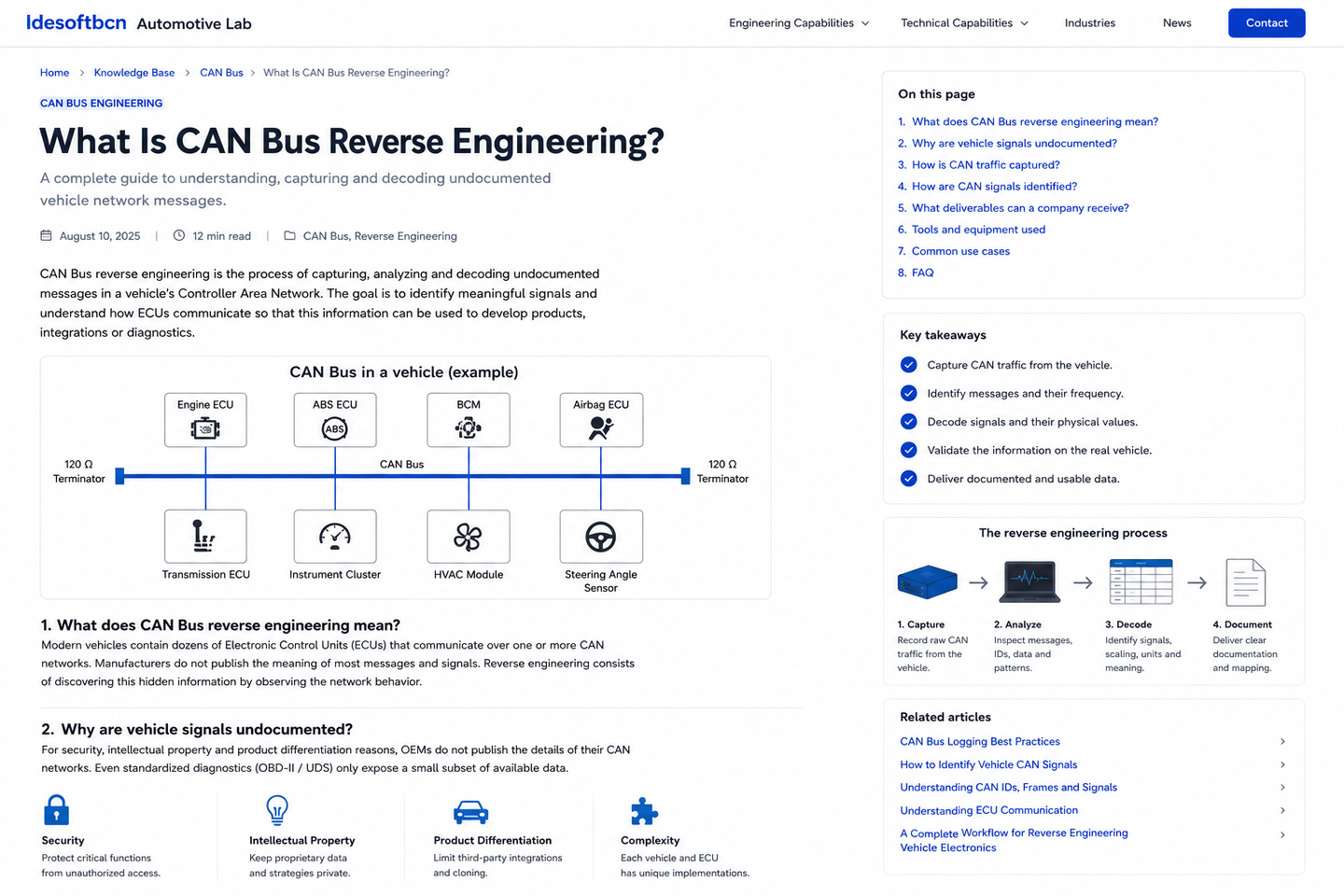
What CAN Bus reverse engineering means
A vehicle may contain thousands of recurring CAN frames. Each frame has an identifier, a payload and a transmission pattern, but the meaning of the bytes is often manufacturer-specific. Reverse engineering combines observation, controlled testing and data analysis to associate changes in the network with physical actions such as switching on a light, opening a door or changing vehicle speed.
Why vehicle signals are often undocumented
Vehicle manufacturers generally do not publish complete signal databases for every model, trim level and production year. Networks also evolve between platforms. A signal discovered in one vehicle cannot automatically be assumed to work in another, so identification must be followed by validation on the target platform.
A typical engineering workflow
The work normally begins with safe access to the relevant network, followed by timestamped captures in known vehicle states. Tests are then repeated while changing one condition at a time. Filtering, comparison, frequency analysis and bit-level inspection help isolate candidate frames. Finally, the signal is decoded, scaled and validated across multiple operating conditions.
From candidate signal to validated signal
A correlation is not yet a validated signal. Engineers must check whether the value is stable, whether it behaves correctly at limits, whether counters or checksums are present and whether the message changes in other vehicle states. Validation reduces the risk of building a product around a misleading coincidence.
Typical project deliverables
Depending on scope, deliverables may include raw capture files, relevant CAN identifiers, decoded bit positions, byte order, scaling and offset information, state tables, test procedures, sample code, integration notes and a validation report.
When companies use this service
Common applications include telematics, fleet systems, alarms, immobilizers, dashcams, retrofit electronics, diagnostic products, lighting systems and connected vehicle prototypes. The same methodology can also support research and proof-of-concept development.
FAQ
Frequently asked questions
Is CAN Bus reverse engineering legal?
The technical activity itself is widely used for interoperability, research and product development, but each project must respect applicable contracts, intellectual property rights, cybersecurity rules and local law.
How long does a CAN reverse engineering project take?
It depends on the number of signals, vehicle access, test complexity and required confidence. A tightly defined signal can be much faster than documenting a complete subsystem.
Can every CAN signal be decoded?
Not necessarily. Some information may be encrypted, generated only under specific conditions or unavailable on the accessible network. A feasibility phase is therefore valuable.
Engineering support
Need help applying this to a real vehicle?
Idesoftbcn Automotive Lab supports CAN Bus reverse engineering, LIN analysis, ECU signal discovery, embedded development and vehicle validation.
Discuss your projectContinue reading