Key points
- Begin with a clearly defined engineering objective.
- Capture raw data with synchronized operating context.
- Treat early decodings as hypotheses, not confirmed facts.
- Validate findings across conditions and vehicle variants.
- Document results so they can be implemented and maintained.
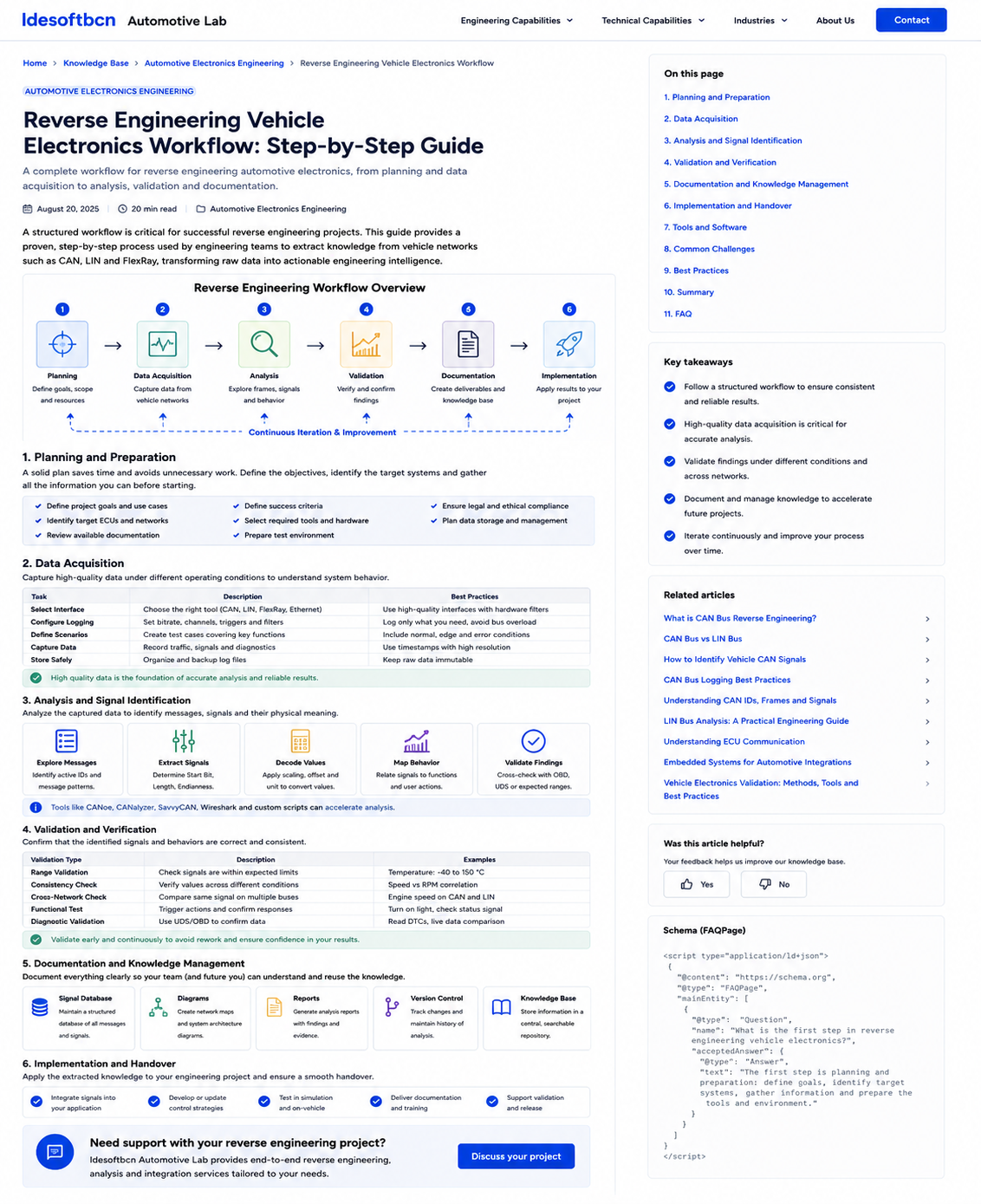
1. Planning and preparation
Before connecting any tool, define the business and engineering objective. The method changes depending on whether the goal is to decode a signal, reproduce an ECU behavior, build a gateway or document an entire vehicle network.
- Define the target function, vehicle variants and success criteria.
- Identify relevant ECUs, connectors, networks and access points.
- Review wiring diagrams, diagnostic information and existing recordings.
- Select interfaces, breakout hardware, measurement tools and analysis software.
- Plan safe test scenarios and protect the vehicle from unintended commands.
- Define file naming, timestamps, metadata and version-control rules.
2. Data acquisition
High-quality data is the foundation of every conclusion. Record raw network traffic together with enough contextual information to explain what the vehicle was doing.
| Task | Purpose | Best practice |
|---|---|---|
| Select the interface | Access CAN, CAN FD, LIN or Ethernet. | Use reliable hardware with accurate timestamps. |
| Configure the session | Set bit rate, channels and error capture. | Verify settings with a short baseline recording. |
| Define scenarios | Produce controlled changes in vehicle state. | Change one variable at a time where possible. |
| Capture context | Correlate data with physical behavior. | Record actions, diagnostics, video or measurements. |
| Preserve raw files | Protect the original evidence. | Store immutable originals and analyze copies. |
3. Analysis and signal identification
Analysis converts recordings into hypotheses about messages, signals and system behavior. Start with broad traffic exploration and narrow the search through controlled comparisons.
- List message identifiers, rates, lengths and error activity.
- Compare recordings from different vehicle states.
- Inspect changing bytes and bits.
- Identify counters, flags, checksums and multiplexing.
- Determine byte order, signedness, length, scaling and offset.
- Record a confidence level for every candidate signal.
4. Validation and verification
A plausible decoding is not yet a confirmed result. Candidates should be tested under different conditions and compared with an independent reference whenever possible.
| Validation type | Question | Example |
|---|---|---|
| Range validation | Are values within credible limits? | Temperature, angle, voltage or speed range. |
| Correlation validation | Does the value match another source? | CAN speed compared with GPS or diagnostics. |
| Repeatability | Does the same action produce the same result? | Repeated switch or actuator operation. |
| Cross-vehicle validation | Does the decoding survive variants? | Different model year, trim or ECU software. |
| Fault validation | What happens during invalid or missing data? | Timeout, disconnected module or error state. |
5. Documentation and knowledge management
Reverse engineering loses value when findings remain only in temporary notes or tool projects. Documentation should allow another engineer to reproduce the result.
- Maintain signal databases with ID, start bit, length, byte order, scaling, offset and units.
- Create network maps showing buses, gateways, ECUs and diagnostic paths.
- Store test scenarios, raw evidence and confidence status.
- Document counters, checksums, rolling codes and validity conditions.
- Version-control scripts, databases, firmware and reports.
- Record the vehicle and software variants covered by each result.
6. Implementation and handover
The decoded information can support gateways, telemetry systems, diagnostic tools, retrofit modules, validation platforms or software APIs.
- Define the integration contract: inputs, outputs, timing and failure behavior.
- Implement decoding or transmission: firmware, software or database rules.
- Add safeguards: plausibility checks, timeouts and safe states.
- Test in simulation and on the bench: include malformed and missing data.
- Validate on the vehicle: confirm timing, compatibility and behavior.
- Deliver maintainable assets: documentation, code, binaries and test evidence.
7. Tools and software
A practical workflow may combine network interfaces, oscilloscopes, diagnostic clients, packet-analysis tools, DBC editors, scripting languages, embedded development environments and HIL or bench simulation equipment.
8. Common challenges
- Multiple networks may carry transformed versions of the same signal.
- Gateways can filter, translate or delay messages.
- Some values are multiplexed or available only in specific states.
- Counters, checksums and rolling security values complicate transmission.
- Vehicle variants may use different identifiers or scaling.
- Diagnostic traffic can be confused with normal operational traffic.
9. Best practices
- Change one physical variable at a time during discovery.
- Preserve raw recordings and analysis scripts.
- Use synchronized context such as video or diagnostic data.
- Maintain confidence levels for decoded signals.
- Validate across operating states and vehicle variants.
- Separate observation from inference in documentation.
- Automate repeatable comparisons and regression tests.
- Review safety, legal and cybersecurity constraints before implementation.
FAQ
Frequently asked questions
What is the first step in reverse engineering vehicle electronics?
The first step is planning: define the objective, identify the target system and networks, review available information and prepare the required tools and test environment.
Which data should be captured during a reverse engineering project?
Capture raw network traffic together with timestamps, vehicle state, user actions, diagnostic responses and any physical measurements needed to correlate system behavior.
How are undocumented vehicle signals identified?
Engineers compare recordings from controlled scenarios, isolate changing messages, inspect bytes and bits, derive scaling and units, and validate candidates on the real vehicle.
Why is validation necessary?
Validation confirms that decoded signals and inferred behaviors remain correct across operating conditions, vehicles, network states and repeated tests.
What should be delivered at the end of a project?
Typical deliverables include signal databases, network maps, decoding rules, test evidence, implementation guidance, reports and version-controlled documentation.
Reverse engineering support
Need a complete vehicle electronics investigation?
Idesoftbcn Automotive Lab provides CAN and LIN analysis, signal decoding, embedded implementation and real-vehicle validation.
Discuss your projectContinue reading