Key points
- Validation confirms that vehicle electronics satisfy real operating needs.
- Bench, HIL and real-vehicle testing provide complementary evidence.
- Every test should be connected to a requirement, risk or failure mode.
- Hardware, firmware, calibration and test versions must be traceable.
- Final confirmation on the real vehicle remains essential.
1. What is the vehicle validation process?
The vehicle validation process provides evidence that an electronic system is suitable for its intended use. It considers the complete result: hardware, firmware, network communication, power behavior, installation, diagnostics and interaction with the vehicle.
Validation complements verification. Verification determines whether the system was built according to its specification. Validation determines whether the specified and implemented system performs correctly in realistic use.
2. Validation across the development lifecycle
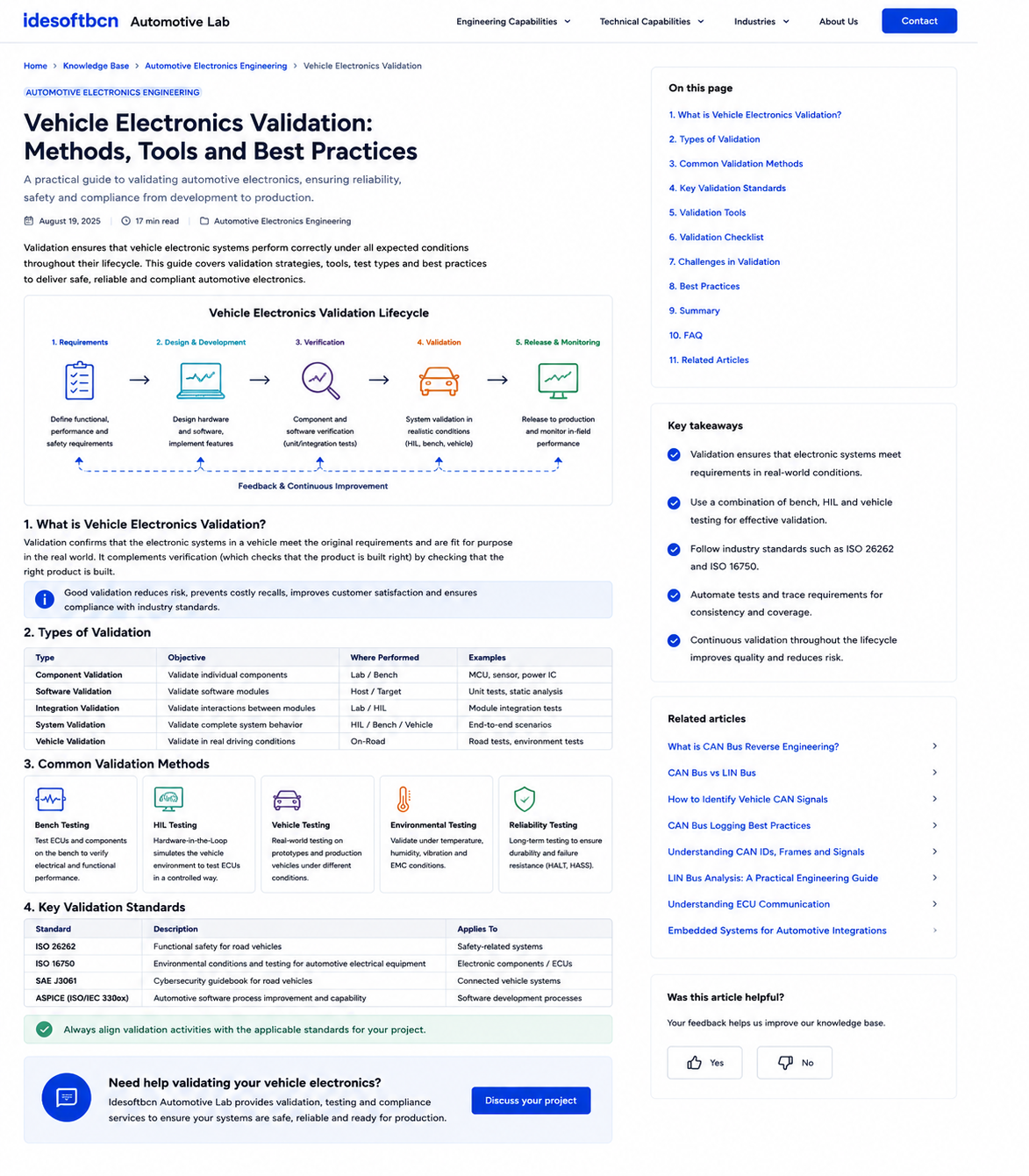
Validation should not be postponed until a prototype is installed in a vehicle. Planning begins with requirements and continues through design, implementation, integration, system testing and release monitoring.
| Stage | Main activity | Typical evidence |
|---|---|---|
| Requirements | Define functions, interfaces, limits and failure behavior. | Reviewed and testable requirements. |
| Design and development | Plan hardware, firmware, diagnostics and testability. | Design reviews and analysis results. |
| Verification | Confirm components and software match the design. | Unit, integration and bench test reports. |
| Validation | Confirm system behavior in realistic conditions. | HIL, rig and vehicle test evidence. |
| Release and monitoring | Control baselines and review field performance. | Release record, issue tracking and regression results. |
3. Types of automotive electronics validation
| Type | Objective | Environment | Example |
|---|---|---|---|
| Component validation | Validate an individual electronic component. | Laboratory bench. | MCU, transceiver or power circuit. |
| Software validation | Validate algorithms and firmware behavior. | Host, simulator or target hardware. | State machines and diagnostic services. |
| Integration validation | Validate interfaces between modules. | Bench or HIL. | ECU and gateway communication. |
| System validation | Validate end-to-end functions. | HIL, system rig or vehicle. | Complete operating scenarios. |
| Vehicle validation | Validate installation and real-world operation. | Workshop, road or proving ground. | Power modes, network timing and user interaction. |
4. Common validation methods
Bench testing
Bench testing uses programmable power supplies, loads, network interfaces and measurement equipment to exercise an ECU or prototype under controlled conditions. It is well suited to electrical measurements, communication tests and repeatable functional checks.
Software-in-the-loop testing
Software-in-the-loop testing executes application logic or models without the final electronic hardware. It provides fast feedback for algorithms, state transitions and boundary conditions.
Hardware-in-the-loop testing
Hardware-in-the-loop testing connects real electronic hardware to a simulated vehicle environment. Sensors, actuators, networks and faults can be reproduced safely and repeatedly without requiring a complete vehicle.
Fault injection
Fault injection introduces missing messages, invalid values, timing disturbances, power interruptions, open circuits or short circuits. These tests confirm diagnostic coverage, recovery behavior and safe states.
Real-vehicle testing
Vehicle testing validates installation effects, gateway behavior, network load, power transitions, environmental conditions and user interaction. It is the final confirmation that bench conclusions remain valid in the target platform.
5. Relevant standards and frameworks
The applicable standards depend on the function, market, production context and level of risk. They should be identified during requirements planning.
| Standard or framework | Area | Typical relevance |
|---|---|---|
| ISO 26262 | Functional safety. | Safety-related electrical and electronic systems. |
| ISO 16750 | Environmental and electrical conditions. | Automotive electrical and electronic equipment. |
| ISO 7637 | Electrical transients. | Conducted disturbances on vehicle supply lines. |
| CISPR 25 / ISO 11452 | Electromagnetic compatibility. | Emissions and immunity validation. |
| ISO/SAE 21434 | Cybersecurity engineering. | Connected and software-defined vehicle systems. |
| Automotive SPICE | Development process capability. | Traceability, process control and evidence. |
6. Validation tools
- Programmable power supplies and electronic loads.
- Oscilloscopes, current probes and logic analyzers.
- CAN, CAN FD, LIN and Automotive Ethernet interfaces.
- Diagnostic clients for UDS and DoIP.
- HIL systems and real-time plant models.
- Environmental and electromagnetic compatibility facilities.
- Automated test frameworks and requirements-traceability tools.
7. Practical validation checklist
- Every test maps to a requirement, risk or known failure mode.
- Pass and fail criteria are defined before test execution.
- Hardware, firmware, calibration and configuration versions are recorded.
- The test setup and measurement equipment are documented.
- Normal, boundary and fault conditions are covered.
- Startup, shutdown, sleep and wake-up transitions are tested.
- Network timing, bus load and diagnostic behavior are measured.
- Failures are reproducible and linked to corrective action.
- Final results are reviewed before release.
8. Best practices
- Plan validation while requirements are being written.
- Prioritize test coverage using risk and system complexity.
- Automate stable and repetitive scenarios.
- Preserve raw evidence, not only final pass or fail results.
- Repeat critical tests after hardware, firmware or calibration changes.
- Use synchronized network, power and application logging for intermittent faults.
- Complete final validation on the real vehicle.
FAQ
Frequently asked questions
What is the vehicle validation process?
The vehicle validation process confirms that electronic hardware and software meet their requirements and operate correctly under realistic vehicle conditions.
What is the difference between verification and validation?
Verification checks whether a system was built according to its specification. Validation checks whether the finished system is suitable for its intended real-world use.
Why is hardware-in-the-loop testing useful?
Hardware-in-the-loop testing connects real electronic hardware to a simulated vehicle environment, allowing normal, boundary and fault scenarios to be reproduced safely and repeatedly.
Is real-vehicle testing still necessary after bench and HIL testing?
Yes. Real-vehicle testing confirms installation effects, network interactions, power behavior and operating conditions that cannot be reproduced completely on a bench.
Validation engineering support
Need help with a vehicle validation process?
Idesoftbcn Automotive Lab supports bench integration, CAN and LIN analysis, test development, fault reproduction and real-vehicle validation.
Discuss your projectContinue reading